The short answer
If you've inherited or rediscovered a box of old sports cards, here's the truth up front: most of them are probably worth pennies. The cards that fill the average attic shoebox were printed during the late 1980s and early 1990s, a stretch collectors call the "junk wax era," when manufacturers cranked out cards by the tens of millions. There are simply too many of them for most to carry meaningful value — even ones with famous players on the front.
The real money in sports cards lives in a few specific places: genuinely old vintage cards (pre-1970), the rookie cards of Hall-of-Fame players, cards with low print runs, and cards in exceptional, professionally graded condition. The goal of this guide is to help you tell the difference between the common stock and the few cards actually worth checking — without the hype.
What makes a sports card valuable
Collector value isn't random. It comes down to a handful of factors that stack together. Understanding them lets you scan a box quickly and pull the cards worth a second look.
- Player & rookie status. A star player matters, but a player's rookie card — their first official card — almost always commands a premium over later cards of the same athlete. A Hall-of-Famer's rookie is the holy grail of any set.
- Year & set. Older is generally scarcer and more desirable. A 1950s Topps or Bowman card lives in a different universe from a 1990 issue. Some specific sets and series are also harder to find than others from the same year.
- Condition. This is the big one. Centering (how evenly the image sits inside the borders), sharp corners, clean surfaces, and crisp edges drive value enormously. The same card can be worth ten times more in pristine shape than in well-loved condition.
- Grading (PSA / BGS / SGC). Third-party grading companies authenticate a card and assign it a numeric grade, sealing it in a tamper-proof holder. A PSA 10 "Gem Mint" is the top grade and can multiply a card's value, because verified high grades are scarce.
- Scarcity & print run. The fewer that exist, the more collectors pay. Short-printed cards, low serial-numbered parallels (like "23/99"), and pre-war cards with tiny surviving populations are where steep values come from.
- Autographs & relics. An on-card autograph or an embedded swatch of game-worn jersey or bat can add value — especially when it's certified by the manufacturer or a grading service.
The junk wax era — why most 1987–1994 cards aren't worth much
In the late 1980s, sports cards exploded into a national hobby and manufacturers responded by printing staggering quantities to meet demand. Companies like Topps, Donruss, Fleer, Score, and Upper Deck flooded the market. The result is an era — roughly 1987 to 1994 — where supply massively outstrips collector demand to this day.
That's why a box of crisp, good-looking cards from this period can still be nearly worthless. It's not about the condition or even the players; it's simple economics. Millions of people saved these cards in the same mint condition, so "mint" stopped being special. A 1990 card of a superstar might sell for less than a dollar, while a far rarer card of a lesser player from the 1950s sells for hundreds.
This isn't a reason to throw the box out. There are real exceptions hiding in junk wax — certain key rookie cards, scarce inserts, and famous error cards still trade for real money, and anything that grades at the very top can outrun the era's reputation. But it does mean you should set expectations honestly: the bulk is common.
Cards that ARE worth checking
Here's where to focus your attention. If a card falls into one of these buckets, it's worth identifying carefully rather than tossing in the "common" pile.
Red flags / condition killers
Even a desirable card loses most of its value if the condition is poor. Collectors and graders are unforgiving, and these issues are the most common value-killers. Look at your card under good light and check for:
- Creases. Any bend or wrinkle through the card, even a faint one, sharply reduces value. Tilt the card in the light to spot them.
- Off-center images. If the borders are noticeably wider on one side, centering is poor — one of the first things a grader penalizes.
- Rounded or soft corners. Sharp, crisp corners are essential for a high grade. Fuzzy or dinged corners drop a card several grades.
- Surface wear. Scratches, scuffs, print lines, gloss loss, or stains on the front all hurt. Gum stains on old cards are common and count against condition.
- Writing, tape, or trimming. Ink marks, tape residue, and especially trimmed edges (cutting a card to fake better borders) can make a card unsellable to serious collectors.
How to find out what YOURS is worth
You don't need to be an expert to get a credible read on a card. You need a clear photo and a tool that can identify the card and estimate its current collector value. Here's how to get a clean result:
Lay it flat
Place the card on a plain, dark surface, front up. Keep it square to the camera so the borders look even.
Use even light
Soft, indirect daylight beats flash. Avoid glare and shadows so the player name, year, and set are crisp and legible.
Upload & read the report
The sports card analyzer identifies the card and gives a current collector value estimate in seconds.
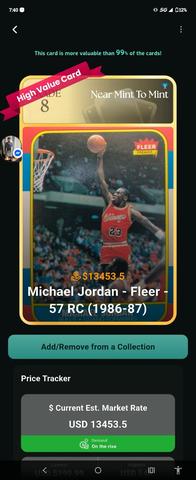
artiFACT's sports card analyzer handles the identification — player, year, set, and likely card type — and returns an estimated collector value based on what collectors are currently paying and what comparable cards are listed for. It's a fast way to triage a whole box: photograph the few cards that fit the "worth checking" categories above and let the analysis tell you which ones deserve a closer look or professional grading.
New to a big pile of inherited cards? Start with our guide on where to start with an inherited collection, and if your box mixes in other paper collectibles, see whether old postcards are worth money too. You can browse all our value guides for more.
Signs a card might be worth real money
Run down this quick checklist. The more boxes a card ticks, the more worthwhile a closer look becomes.
- It's from before 1970 — pre-war tobacco or early Topps/Bowman.
- It's a rookie card of a Hall-of-Famer or a genuine all-time great.
- It's already graded (in a PSA, BGS, or SGC holder) with a high number.
- It carries a serial number or is a known short print.
- It has a certified autograph or an embedded jersey/bat relic.
- The condition is genuinely clean — sharp corners, well-centered, no creases.
- It's a documented error or variation collectors actually chase.
If a card hits none of these — and it's a common name from the late 80s or early 90s — it's almost certainly common stock. That's not a disappointment so much as useful information: it tells you where to spend your time.